
Most enterprise CMS transformations don’t fail.
They go live.
And then, quietly, they stall.
The website launches. The platform is modern. The upgrade pain disappears. On paper, everything looks successful.
Yet months later:
- Marketing speed hasn’t meaningfully improved
- Technology teams are still firefighting
- Transformation leaders are explaining again why momentum hasn’t arrived.
This isn’t a tooling problem.
It’s a leadership problem disguised as a technology one.
And it’s why many enterprises are now re-thinking the CMS model itself, not just replacing platforms.
What this article argues:
The problem with enterprise CMS initiatives isn’t the platform; it’s the operating model that surrounds it. And that distinction is where outcomes quietly diverge.
The Misdiagnosis at the Heart of CMS Modernization
For years, CMS decisions have been framed as technology upgrades.
- Legacy platform becomes risk-heavy.
- Upgrades become expensive.
- Teams modernize to “fix the problem.”
But what if upgrades were never the real issue?
In enterprise environments, the true cost of traditional CMS platforms is not versioning or infrastructure.
It’s organizational drag: the friction created when content, architecture, and ownership are tightly coupled.
The symptoms are familiar:
- Marketing waits.
- Technology absorbs risk.
- Transformation stalls between phases.
Most leadership teams sense this friction, but mislabel it as execution inefficiency or resistance to change.
In reality, the system is behaving exactly as it was designed to.
Why Speed and Stability Keep Cancelling Each Other Out
Enterprise CMS platforms were built for a different era; when
- Websites were static
- Release cycles were predictable
- Digital change was episodic.
Today’s expectations are different.
- Content must move continuously.
- Experiences must adapt in real time.
- Governance must scale without slowing execution.
Yet many organizations still operate on a CMS model that forces trade-offs:
- Speed requires risk
- Control requires delay
- Governance requires compromise
This tension isn’t cultural or operational.
It’s structural.
And as long as the structure remains unchanged, no amount of tooling improvement will resolve it.
The Leadership Reframe Most Organizations Avoid
At this point, many enterprises assume the answer is a “better CMS.”
But the deeper issue is not capability.
It’s responsibility.
Traditional CMS platforms place the burden of platform evolution squarely on the organization.
- Platform upgrades compete with business priorities
- Stability and security absorb leadership attention
- Performance becomes a maintenance concern, not a growth lever
This is the constraint leaders feel, even when they struggle to name it.
What XM Cloud Changes Beyond the Technology
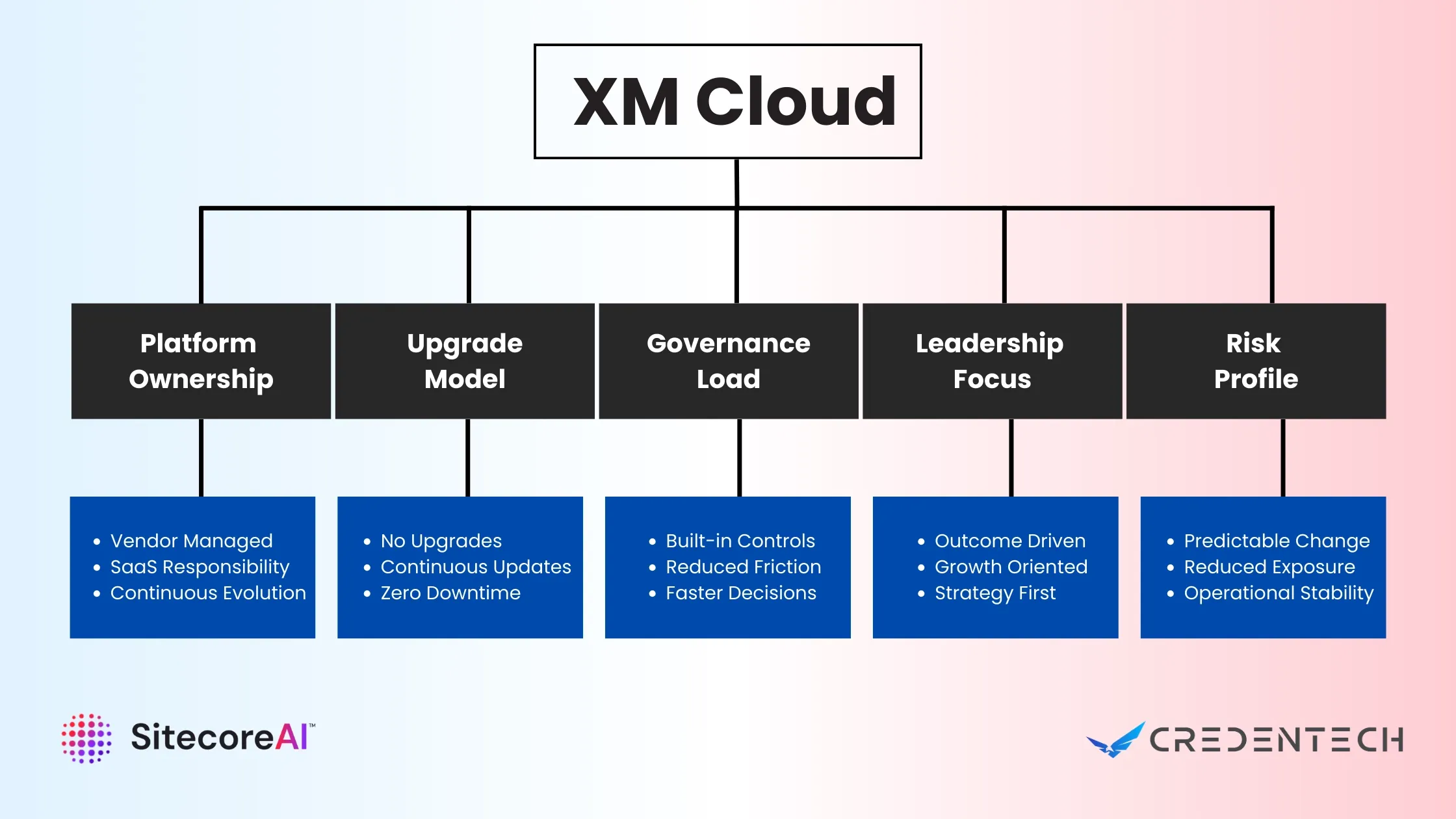
XM Cloud is often described as a SaaS, headless CMS. That description is accurate, but incomplete.
What XM Cloud actually represents is a shift in enterprise CMS modernization: from episodic upgrade projects to a continuously evolving operating model.
The more important shift is this:
Responsibility for platform evolution moves away from the enterprise.
In practical terms, this removes an entire class of work from leadership agendas:
- No upgrade projects to plan.
- No version jumps to stabilize.
- No infrastructure trade-offs with business priorities.
This doesn’t make the platform “simpler.”
It makes the organization lighter.
When updates, security, and performance are handled continuously, leadership attention shifts away from maintenance and toward outcomes.
That is the difference between modernization as an event and modernization as an operating model.
The Risk Leaders Often Discover Too Late
Here’s the uncomfortable truth:
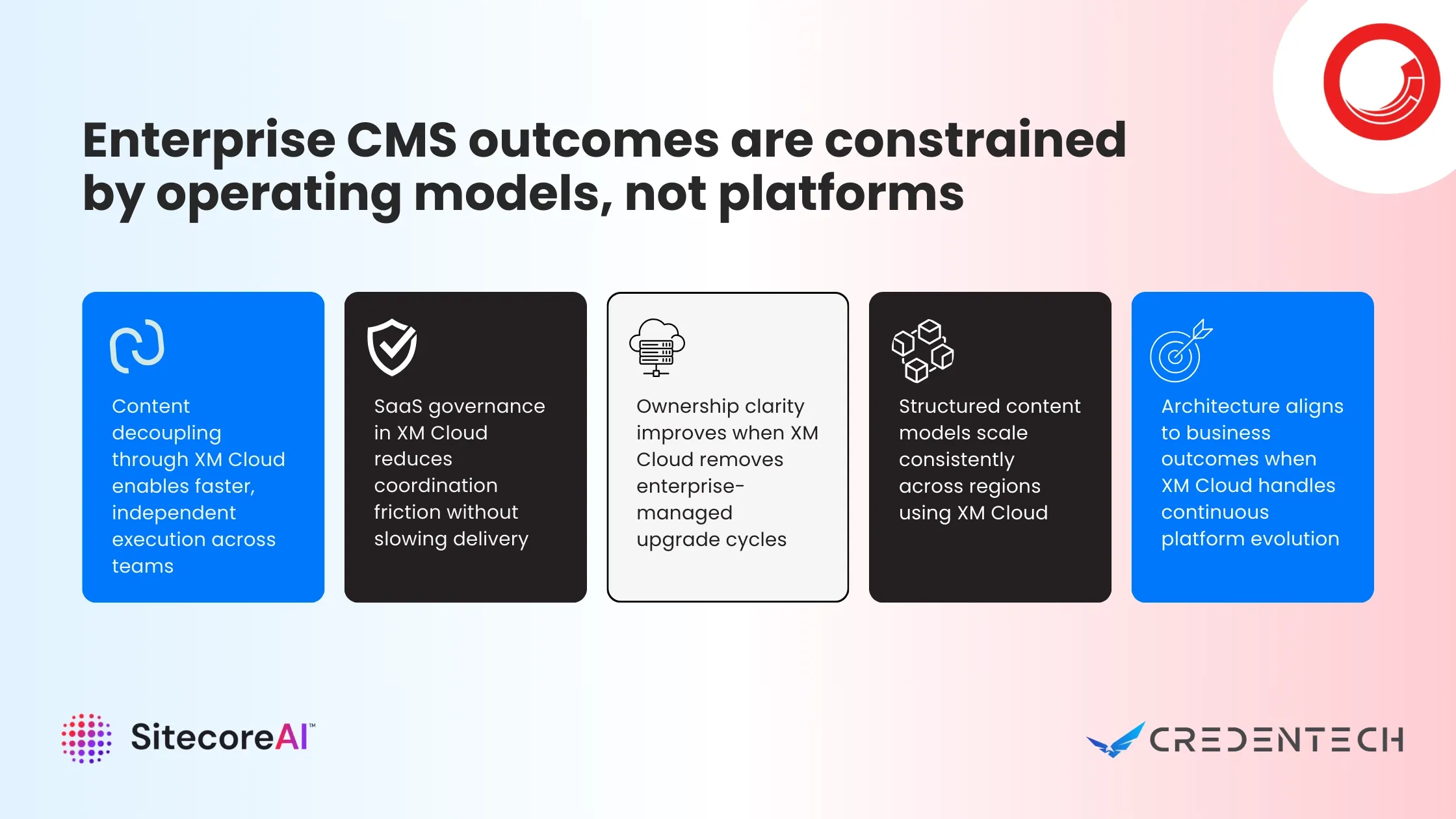
XM Cloud removes platform friction.
It does not remove organizational friction.
When XM Cloud is treated as a technical migration:
- Content models remain inconsistent.
- Governance is deferred.
- Ownership boundaries stay unclear.
The result is predictable:
The platform is modern. The operating model is not.
This is why some organizations “adopt” XM Cloud without ever fully benefiting from it.
What Successful XM Cloud Programs Get Right
When XM Cloud is implemented with structural intent, the early signals are operational, and they appear quickly.
- Publishing becomes predictable instead of negotiated.
- Content reuse becomes normal instead of aspirational.
- Coordination overhead drops because teams stop working around the platform.
These changes matter because they alter how the organization operates day to day.
Over time, the impact compounds:
- Platform risk steadily fades.
- Maintenance effort declines instead of spiking around releases.
- Marketing and technology teams stop trading speed for control.
At that point, the platform is no longer the constraint.
It evolves quietly.
The structure holds.
And the organization moves forward without friction.
Why Execution Discipline Determines Outcomes
This is where many programs diverge.
Some organizations treat XM Cloud as a cleaner replacement for an aging CMS.
Others recognize it as a chance to reset how content, governance, and ownership actually function across the enterprise.
That distinction determines outcomes.
And it is where execution discipline matters.
Where Credentech Changes the Equation
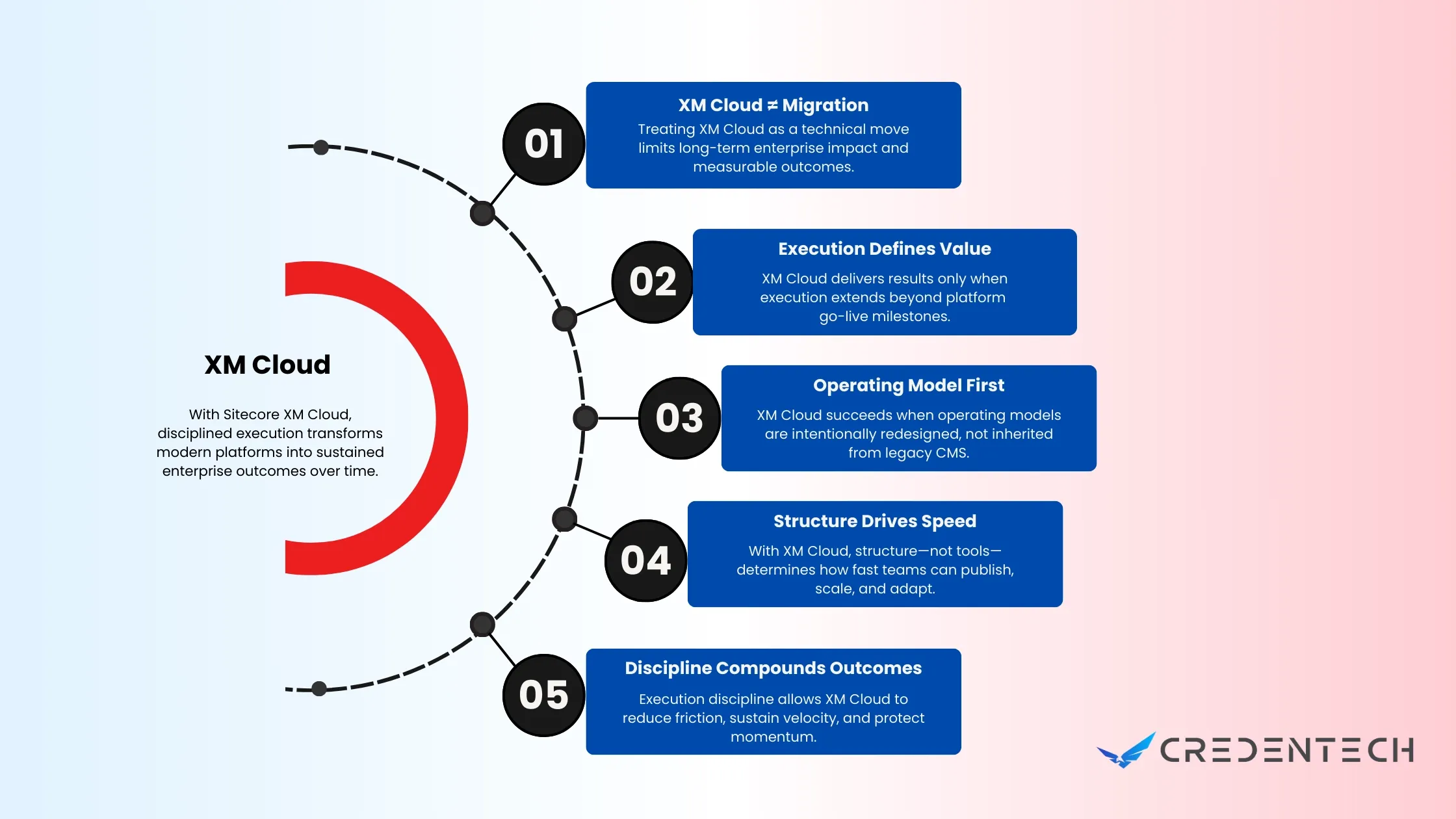
Credentech approaches XM Cloud not as a CMS replacement, but as a structural reset.
Our focus is on three decisions most teams postpone.
- How content should scale across regions and channels
- Where governance must be explicit, not assumed
- How ownership shifts once the platform stops being the bottleneck
Across multi-region, enterprise Sitecore environments, Credentech has seen a consistent pattern: organizations move faster only after the right constraints are redesigned.
A common enterprise scenario looks like this:
In one engagement, Credentech worked with a global organization running multiple Sitecore instances that had grown organically over years. Content was deeply coupled to presentation, reuse was minimal, and every change required negotiation between teams.
Instead of accelerating migration, Credentech slowed the right things down:
- Information architecture was redesigned for scale, not familiarity
- Content schemas were treated as contracts, stabilizing downstream systems
- Legacy components were decoupled incrementally, reducing disruption
Only then did the move to XM Cloud deliver what leadership expected: speed without instability, and governance without friction.
That is the difference between a platform upgrade and a change in operating model.
The Decision Enterprise Leaders Are Now Making
SaaS-based, composable platforms like XM Cloud are no longer a future bet. They are the new baseline.
The real differentiator is no longer whether an organization adopts XM Cloud, but how deliberately enterprise CMS modernization is approached once the platform itself stops limiting speed.
For leaders rethinking the CMS model, the decision is no longer just about selecting the right platform.
It is about choosing a partner who understands that XM Cloud success is structural, not technical and who has already navigated that complexity inside real enterprise organizations.
That is where Credentech fits.