
How enterprises use Sitecore Connect to unify AI, data, and experience at scale
There’s a point in large CX programs where confidence quietly turns into caution, not because anything has gone wrong, but because progress becomes harder to repeat.
One market moves fast while another waits for alignment, and a third relies on workarounds no one planned for. On paper, the organization is "AI-led." In practice, execution feels uneven.
This is usually the moment leaders stop asking whether AI works and start asking why scale feels slower than promised.
The answer rarely sits in the platforms themselves.
It sits in how the enterprise moves.
When intelligence moves faster than the organization can act
Modern CX technology already operates at machine speed. The delay doesn’t come from insight generation; it comes from what happens after insight exists.
As decisions move through teams, markets, systems, and approvals, they tend to slow down. Each handoff introduces interpretation. Each dependency adds friction. Over time, technically correct decisions arrive too late to matter.
This is the kind of friction leaders sense before they can explain it. Nothing is broken. Nothing is down. Yet every attempt to scale feels heavier than the last.
AI hasn’t stalled.
The organization has.
Why this shows up late and why it’s often misdiagnosed
This problem almost never appears early.
Initial AI initiatives operate in protected conditions: tight scope, dedicated teams, visible wins. Momentum builds quickly, and confidence follows.
The friction only emerges when those same capabilities are expected to operate across the enterprise, across regions, brands, and channels that were never designed to move in sync.
At that stage, familiar explanations surface: data quality, adoption, tooling maturity. They sound reasonable, which is why the real issue often goes unnamed.
What’s missing isn’t intelligence.
It’s coordination.
Until intelligence can move coherently across the organization, outcomes remain local and difficult to repeat.
The difference between connecting systems and orchestrating outcomes
Most enterprises approach this as a connectivity exercise. Get the platforms talking. Ensure data syncs. Assume momentum will follow.
But connection alone doesn’t create action.
Integration answers whether systems can exchange information. Orchestration determines whether the organization can act on that information consistently, repeatedly, and at scale.
Without orchestration, teams compensate manually. Process fills the gaps. Over time, those workarounds become institutionalized friction.
This is the inflection point many large CX programs hit, where intelligence exists, but execution depends on coordination rather than capability.
With orchestration in place, intelligence moves as events, not requests. Decisions trigger actions across systems without waiting for alignment calls or custom interventions.
That’s when AI stops being impressive in isolation and starts being dependable in production.
Why APAC enterprises feel this more acutely
In APAC, scale is rarely linear.
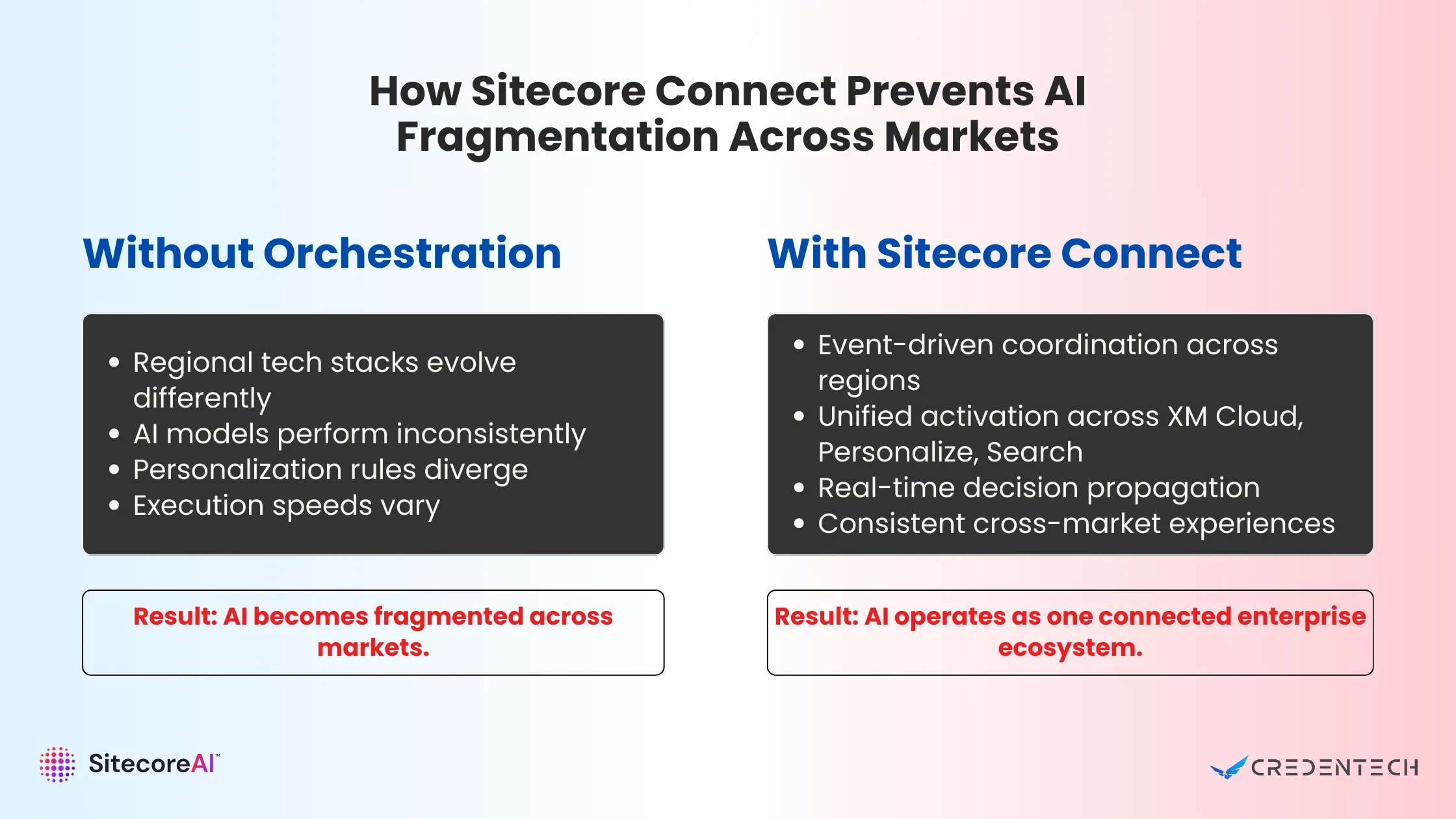
Markets mature at different speeds. Regulatory contexts vary. Technology stacks evolve unevenly. Global intent meets local execution, and coordination becomes the hardest part of the equation.
AI doesn’t remove this complexity.
It exposes where coordination breaks first.
The organizations that move forward are not the ones with the most advanced models, but the ones that introduce a coordination layer capable of keeping pace with intelligence.
Where Sitecore Connect actually fits and where it doesn’t
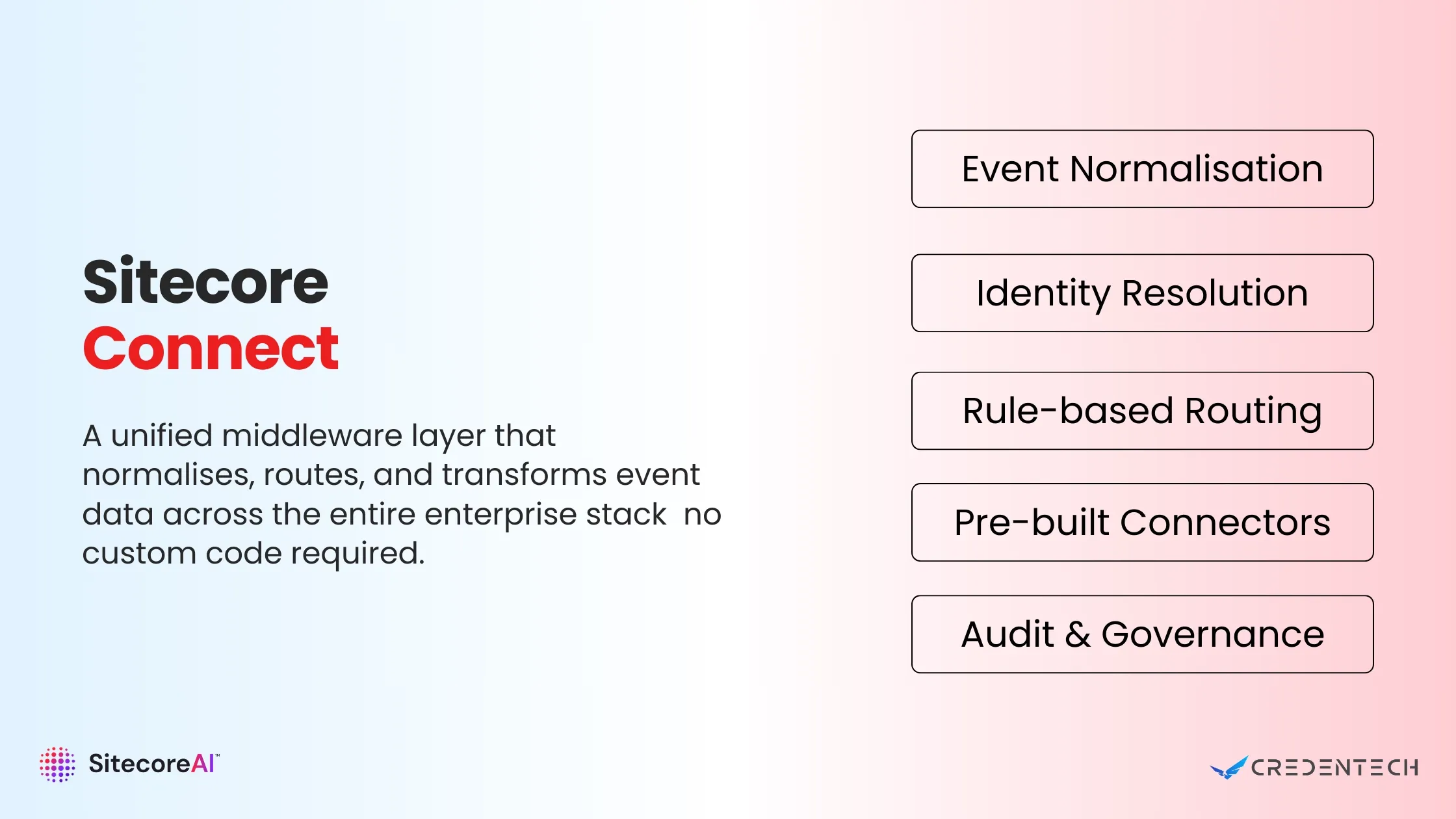
In mature Sitecore ecosystems, this coordination role is increasingly fulfilled by Sitecore Connect - not as middleware, not as “another tool," and not as something teams notice when it’s working.
Its value is structural.
Connect enables intelligence generated across XM Cloud, Personalize, Search, and external systems to move as events, not hand-offs. It allows decisions to propagate across the CX stack without waiting for batch processes, manual intervention, or bespoke point-to-point logic.
This is what allows AI to function as an enterprise capability rather than a collection of local optimizations, which is why orchestration layers like Sitecore Connect become foundational in AI-led CX programs at scale.
When orchestration is absent, AI fragments.
When orchestration is present, AI compounds.
That’s the difference.
The shift leaders don’t always articulate, but feel
In complex, multi-market CX programs, this shift tends to surface only after early success when scaling stops being about capability and starts being about coordination.
When orchestration is working, the change is rarely announced. It’s experienced. CX teams stop waiting for dependencies. Regional execution accelerates without divergence. AI insights translate into action more consistently. Technology discussions shift from "Can we?” to "How fast?"
This isn’t about adding complexity.
It's about removing friction from how intelligence travels through the organization.
That’s why orchestration has quietly become a board-level concern, even if it’s rarely labelled as such.
Why this matters now, not later
As AI capabilities accelerate, the gap between insight and execution widens.
Enterprises that focus only on intelligence creation will continue to struggle with consistency.
Enterprises that invest in orchestration will scale impact without replatforming.
The advantage isn’t better AI.
It’s an organization that can move at the speed AI already operates.
The takeaway most teams arrive at too late
AI does not scale through ambition alone.
It scales when intelligence, data, and experience operate as one coordinated system.
That coordination doesn’t happen by accident.
It requires intent and the infrastructure to support it.
This is why orchestration is no longer a technical afterthought.
It’s an enterprise readiness question.
Where this leads next
If you’re exploring how AI, data, and experience platforms are designed to work together and how orchestration enables that at scale, the next step is understanding the Sitecore AI ecosystem and the role orchestration plays within it.
Explore how Sitecore approaches AI as a connected system and where orchestration becomes the difference between insight and execution.