
Most commerce platforms don’t fail technically, execution slows operationally.
The constraint usually isn’t CX or infrastructure. It’s where order decisions live.
As businesses expand across markets and channels, pricing, routing, and fulfilment rules collide.
In complex regions like APAC, this friction appears earlier due to distributors, marketplaces, and regulatory variation.
High-growth enterprises resolve this by introducing a dedicated order orchestration layer.
Platforms like Sitecore Order Cloud enable this shift through headless order management and enterprise order orchestration.
When Commerce Begins to Slow
Commerce systems rarely collapse overnight. More often, they slow quietly.
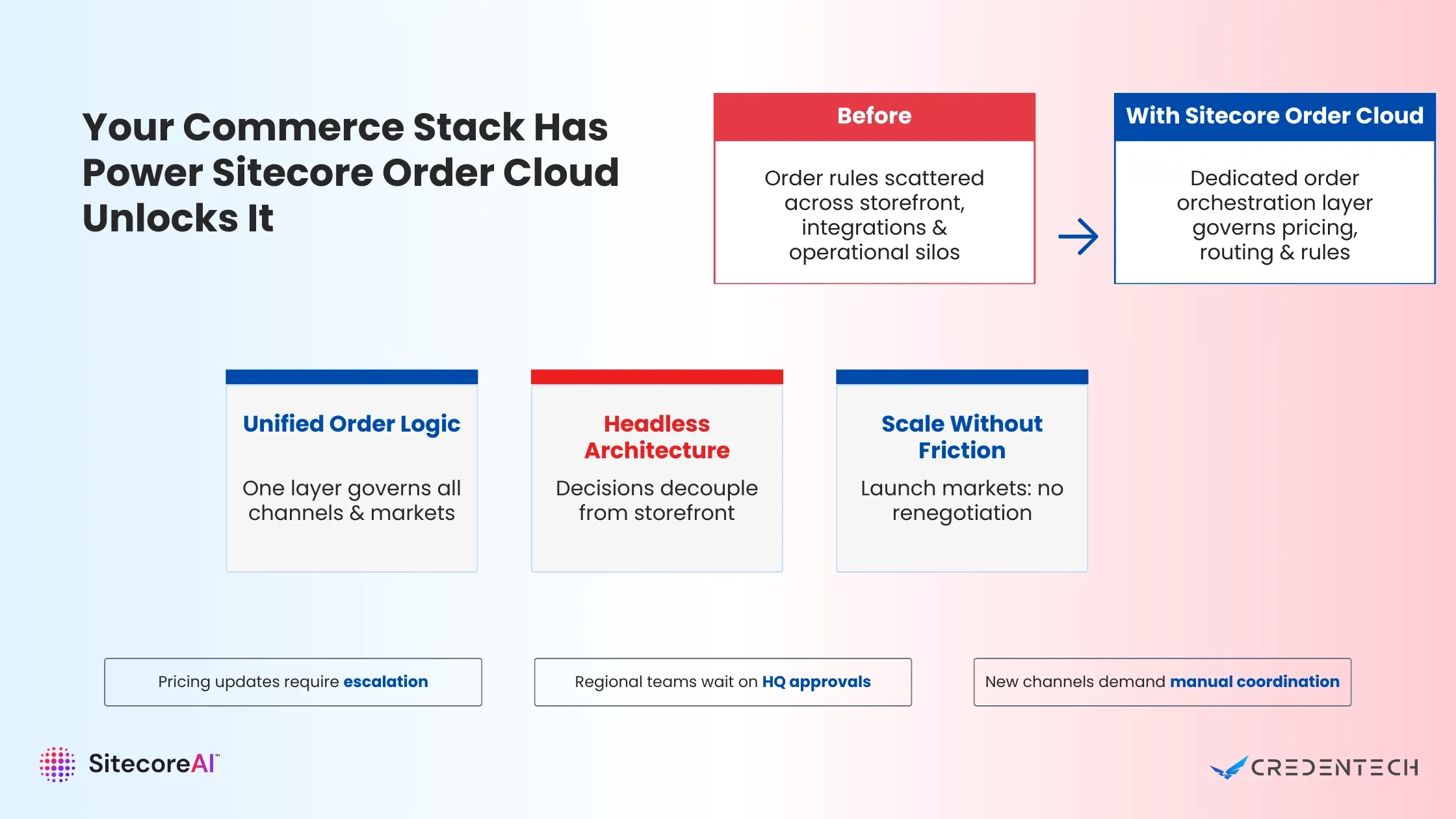
The first signals appear operationally: pricing updates require escalation, launching a new channel involves internal alignment, and regional teams wait on approvals instead of reacting to customer demand.
From the outside the technology looks modern. The storefront works, customer experience metrics remain strong, and the architecture appears capable.
Yet execution begins to lose momentum.
The Constraint Most Teams Don’t See Yet
In most enterprise transformations we review, the problem isn’t missing capability. Organisations have already invested heavily in digital experience platforms, integrations, and composable commerce stacks.
The real constraint appears somewhere else.
Decision authority never moved as the business scaled.
As markets expand, contradictions surface: distributor strategies collide with direct-to-consumer ambitions, regional pricing models conflict with global rules, and marketplace opportunities challenge existing partner agreements.
Commerce continues to grow. But moving forward becomes harder.
Where Order Logic Actually Lives
In practice, order logic governs how commerce truly operates.
It determines which pricing rule wins when markets disagree, how channels resolve priority conflicts, and when exceptions escalate to leadership teams. It also defines whether distributors, partners, and direct-to-consumer channels can coexist without constant negotiation.
Few organisations design this layer intentionally. Rules accumulate across storefront logic, integrations, and operational systems until authority becomes fragmented.
When that happens, execution fragments as well.
Launching in a new market becomes a negotiation exercise. Introducing a new channel requires arbitration between teams. Each expansion adds another layer of coordination that slows decision-making.
From a leadership perspective, the organisation feels slower even though the technology itself remains modern.
Why APAC Reveals the Problem Faster
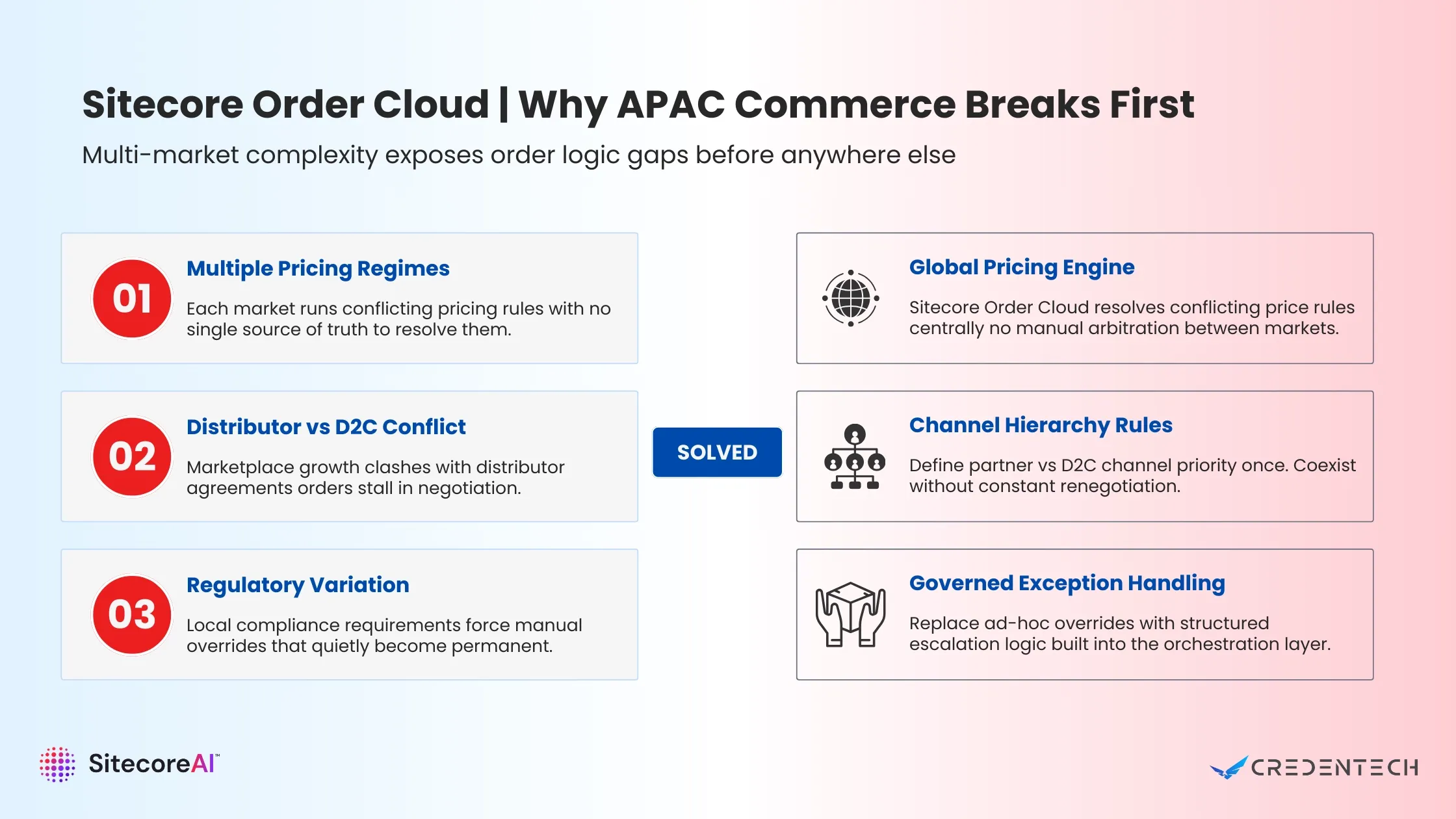
The operational complexity of APAC commerce environments tends to surface these challenges earlier.
Regional growth often involves multiple pricing regimes, distributor-led markets operating alongside marketplaces and direct-to-consumer (D2C) models, and ongoing regulatory variation. At the same time, regional teams are expected to move quickly without losing central governance.
Customer-facing experiences can adapt to these conditions. Front-end systems are flexible.
The pressure instead falls on how orders are governed and executed.
When order logic cannot adapt as quickly as the business evolves, organisations introduce manual overrides. Temporary workarounds gradually become permanent operating patterns.
Externally, the commerce experience still looks flexible.
Internally, operational control weakens over time.
The Gap Between Experience and Execution
When friction appears, many organisations respond by investing further in customer experience.
They launch improved journeys, expand into new channels, and introduce personalisation.
These initiatives are valuable. But experience layers evolve faster than operational decision-making.
Interfaces can mask inconsistencies for a while. Orders cannot.
Every order exposes how pricing rules, channel hierarchies, and fulfilment priorities actually work. When these rules remain scattered across systems, scaling commerce becomes increasingly complex.
This is the moment many global enterprises begin introducing a dedicated enterprise order management and order orchestration layer.
Moving Order Logic Upstream
Organisations that scale successfully rarely replace their entire commerce stack. Instead, they reposition where decisions are made.
Rather than embedding rules inside storefront experiences or integrations, they introduce a layer responsible for governing orders, pricing logic, and routing decisions independently.
For many enterprises, solving this requires introducing a dedicated enterprise order management and order orchestration layer.
Sitecore Order Cloud functions as a headless order management platform designed to orchestrate orders, pricing rules, and fulfilment logic across markets and channels. By separating order decisioning from storefront experiences, it creates a dedicated order orchestration layer where pricing, routing, and partner rules can evolve independently of the customer interface. For enterprises operating across multiple regions, this architectural separation allows commerce systems to scale without introducing operational friction.
When Execution Regains Momentum
Once order orchestration and order decisioning become centralised capabilities, something important changes.
Growth stops triggering negotiation.
Regional teams gain autonomy because operational rules are clearly defined. Channels coexist without destabilising existing partner relationships. Pricing models evolve without disrupting the storefront experience.
The outcome is not perfection.
It is confidence. Confidence that the organisation can scale without redesigning its architecture every time the business changes.
The Next Question Commerce Leaders Ask
Once enterprise order management becomes a defined capability, leadership teams inevitably face a new question.
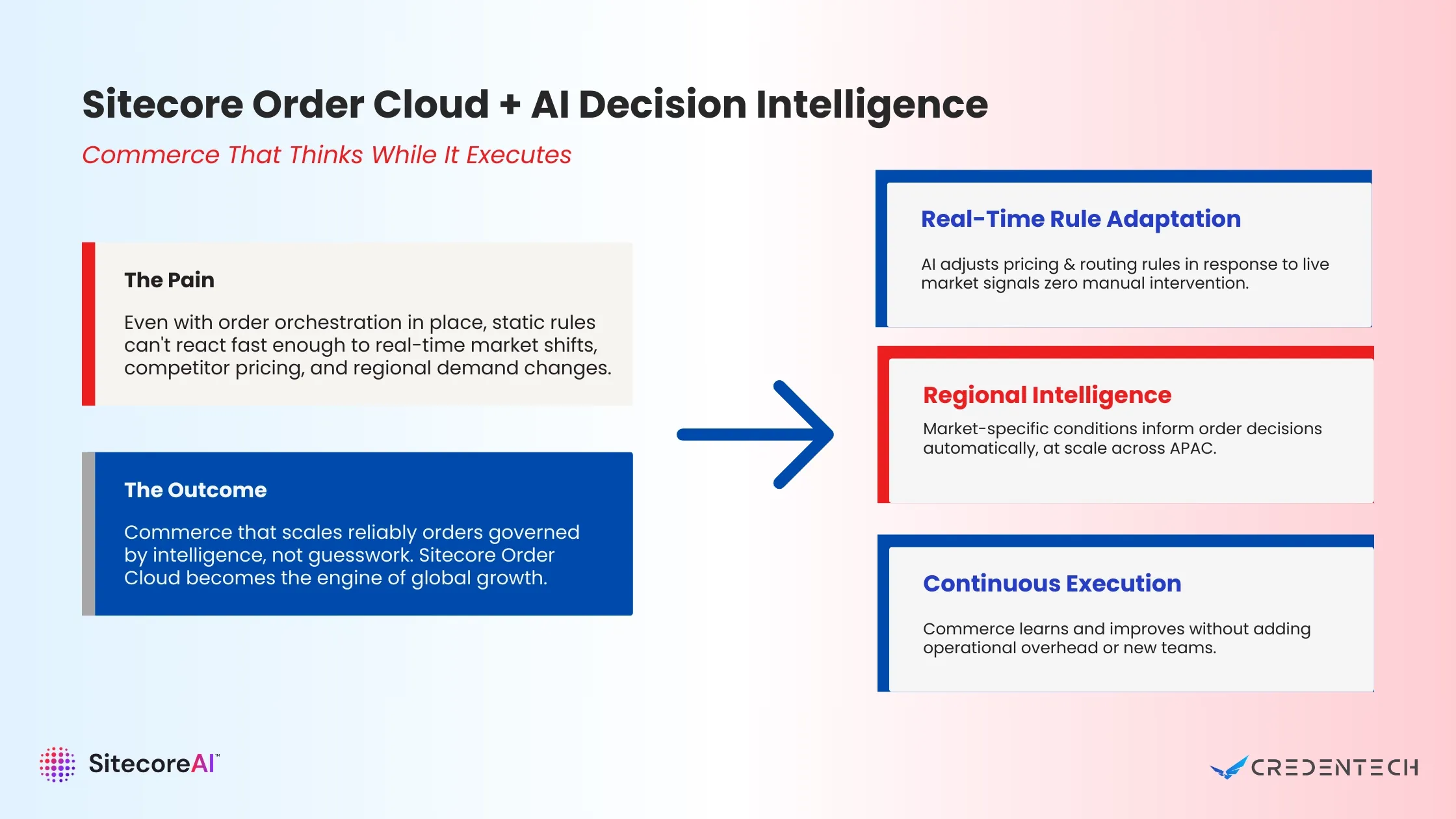
If pricing, routing, and fulfillment decisions are now governed upstream, how can those decisions evolve as quickly as the market itself?
Increasingly, global organisations are exploring how AI-driven operational intelligence can guide these decisions in real time; adjusting rules, responding to regional conditions, and improving execution without introducing new layers of manual control.
This is where the conversation begins to extend beyond commerce platforms alone.
It becomes about designing a system where order orchestration, enterprise order management, and intelligent decision layers operate together.
When Order Logic Meets Intelligence
At Credentech, this perspective shapes how we architect Sitecore-based digital ecosystems connecting Sitecore Order Cloud, composable commerce architecture, and AI-driven decision intelligence into a unified operational model.
For many leadership teams, this is the moment when commerce stops feeling fragile and begins functioning as a reliable engine for global growth.
For teams exploring how AI is beginning to influence modern Sitecore ecosystems, we share additional perspective on our Sitecore AI page.