
The contradiction worth paying attention to
If SaaS is unquestionably the future of digital experience, then the Sitecore Experience Platform (XP) should already be winding down.
It isn’t.
Sitecore continues to invest in XP openly and intentionally. That decision alone challenges a popular assumption: that every enterprise is ready to replace deep, governed experience platforms with SaaS-first models today.
This isn’t a debate about technology direction. That framing misses the point. It’s a question of timing, risk, and operating reality, especially for complex organizations across APAC.
If SaaS were universally ready for every enterprise context, XP would already be sunset. The fact that it isn’t is the signal.
Here’s what that signal actually means for enterprise leaders.
Why Sitecore cannot abandon XP yet
From a vendor strategy perspective, maintaining XP is not sentiment; it’s risk management.
Sitecore serves enterprises where digital experience platforms are deeply embedded into governance models, data responsibilities, regulatory constraints, and long-standing operational workflows. These environments do not change simply because a SaaS alternative exists.
XP remains relevant because it supports:
- Controlled evolution rather than forced replacement
- Continuity across regions with uneven digital maturity
- Experience architectures that cannot be flattened without consequence
Sitecore’s investment reflects a pragmatic understanding: enterprise transformation is staged, not synchronized.
That reality shapes product strategy more than roadmap slogans.
Where SaaS narratives fail at enterprise scale
SaaS simplifies environments that are already aligned.
It destabilizes environments that aren’t.
Across APAC, many organizations operate with:
- Multiple regulatory regimes
- Market-specific customer journeys
- Fragmented data ownership
- Experience logic accumulated over years, not quarters
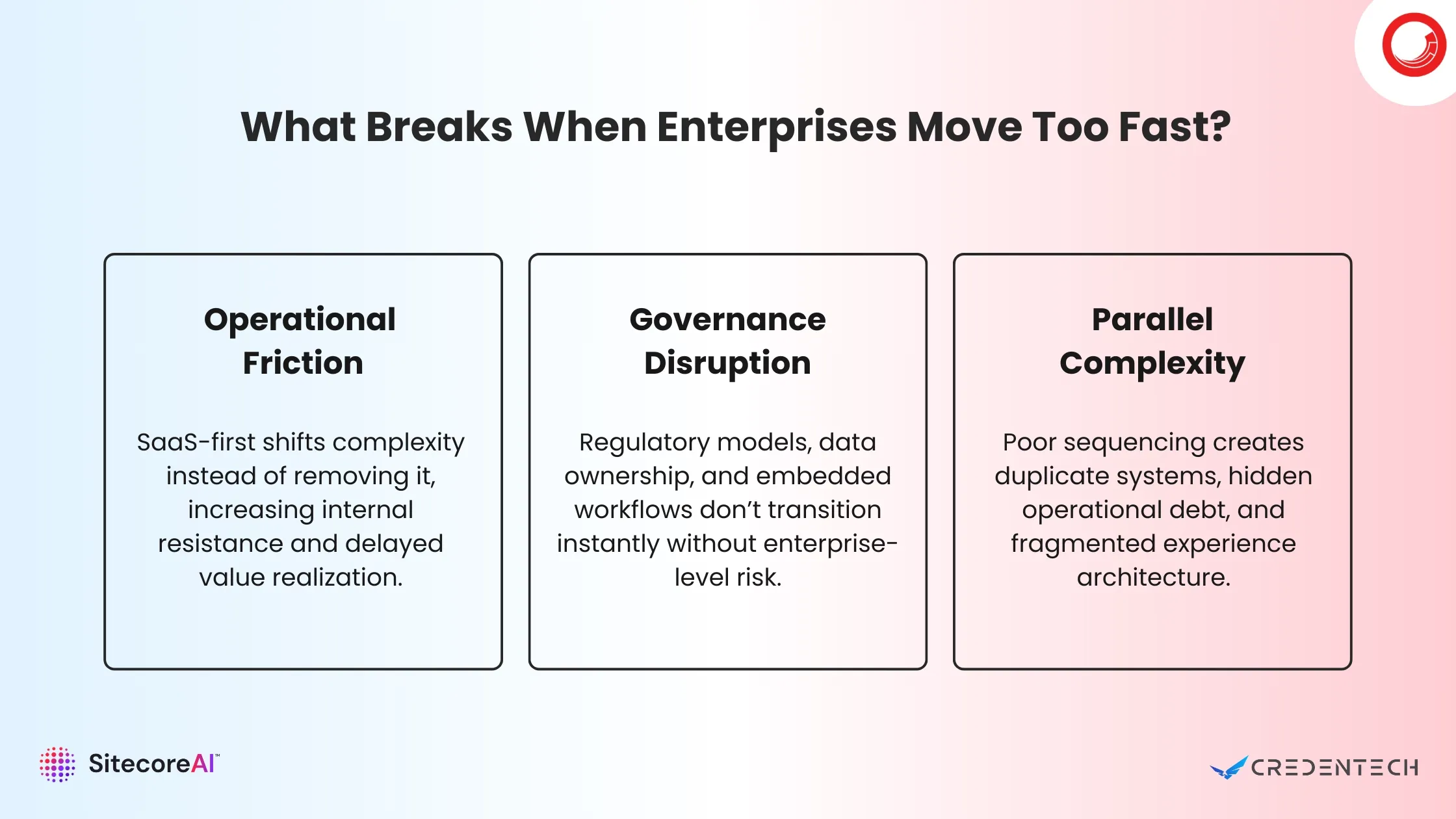
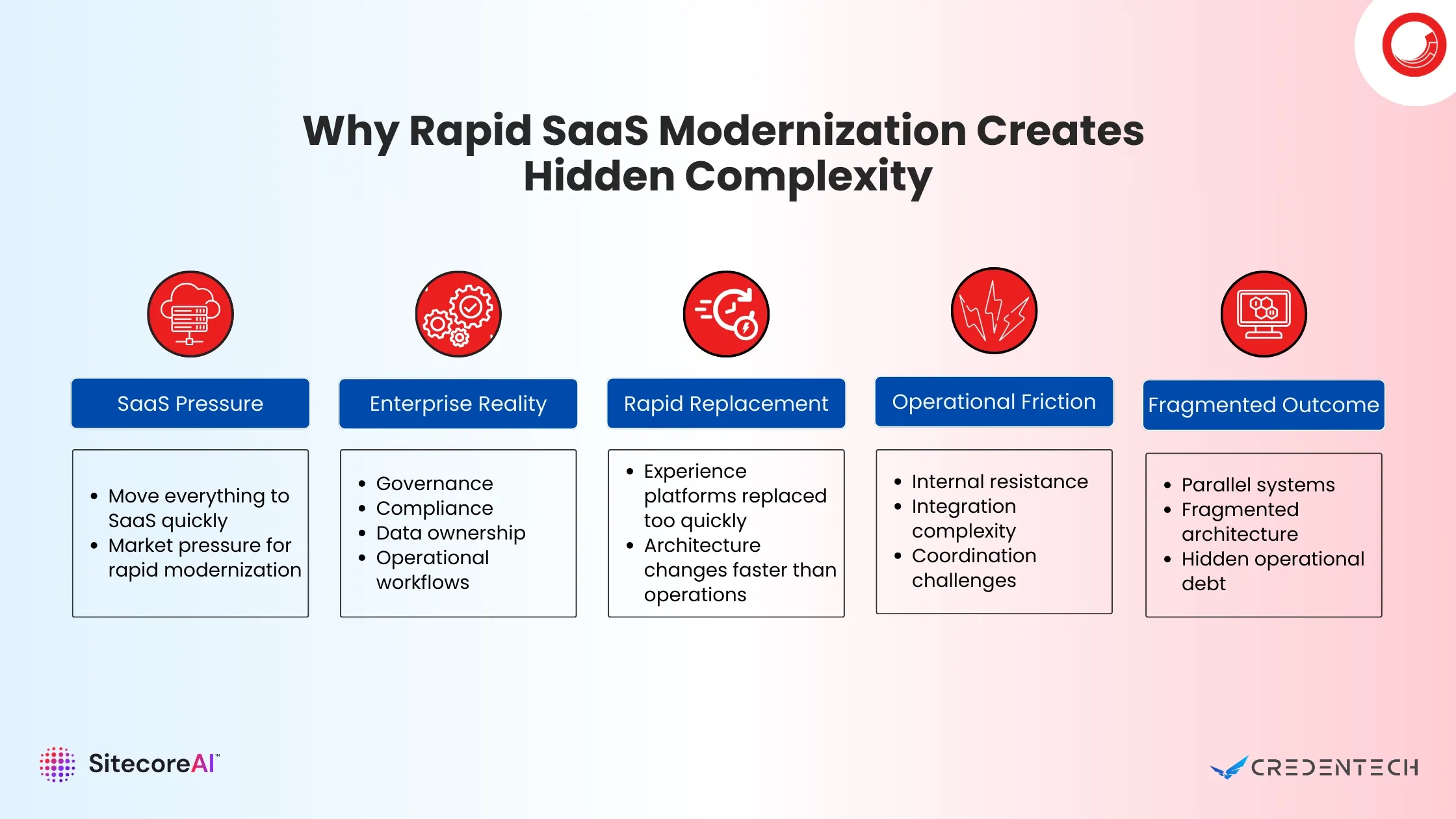
In these contexts, “SaaS-first” often shifts complexity instead of removing it. What appears as modernization on paper can translate into operational friction, delayed value, and internal resistance.
XP persists not because enterprises fear change, but because they understand the cost of sequencing it poorly.
Why XP still anchors enterprise experience stacks
A common mistake is treating XP as an end state.
Sitecore doesn’t.
XP functions as a stabilizing layer while organizations modernize at different speeds across markets, teams, and capabilities. It allows enterprises to introduce SaaS where it makes sense without dismantling what still holds the experience ecosystem together.
This is why XP and SaaS coexist in Sitecore’s strategy.
They serve different moments in an enterprise transformation timeline.
Decision framing for leaders: the real choice
The strategic question is not “XP or SaaS?”
It is about ownership of risk: “What breaks if we move too fast and what stalls if we don’t move at all?”
Some enterprises should accelerate toward SaaS now.
Others should modernize incrementally.
Many need a deliberate sequencing strategy.
Sitecore’s continued investment in XP gives leaders permission to choose timing over trend compliance without being labeled resistant or outdated.
That framing lowers risk. And it’s intentional.
Why APAC enterprises don’t follow uniform SaaS paths
Much of the SaaS conversation is shaped by environments with relatively uniform regulatory and operating models. APAC enterprises rarely fit that profile.
Regional autonomy, compliance variance, and market-specific execution make forced platform uniformity unrealistic in many cases. XP remains relevant here not as legacy, but as infrastructure that absorbs complexity while change happens elsewhere.
In large APAC organizations we work with, this tension between speed and stability is rarely theoretical; it shows up in operating decisions every quarter.
Sitecore’s strategy reflects this reality, even when market messaging simplifies it.
Addressing the skeptical CMO objection (head-on)
“Isn’t staying on XP just delaying the inevitable?”
Only if inevitability is confused with immediacy.
Delaying without intent is risky.
Sequencing with intent is strategic.
XP is not about avoiding SaaS. It’s about ensuring that when SaaS is introduced, it replaces something cleanly rather than creating parallel complexity or hidden operational debt.
That distinction is where many transformations succeed or quietly fail.
What Sitecore’s investment in XP actually signals
When a platform vendor continues to invest, it’s not nostalgia, it’s evidence.
In this case, the evidence suggests:
- XP still solves enterprise-scale experience problems
- Not all organizations are structurally ready to replace it
- Forced simplification carries real risk
For decision-makers, this reframes the conversation from “Are we behind?” to “Are we sequencing this responsibly?”
That shift matters.
What This Means for Enterprise Decision-Makers
XP hasn’t survived because enterprises are slow.
It has survived because transformation at scale is rarely linear.
Sitecore’s continued investment is not a contradiction of its SaaS future; it is an acknowledgement of present-day enterprise reality.
For organizations navigating complexity rather than chasing narratives, that clarity is an asset.
A quiet next step
If you’re reassessing how experience platforms, SaaS, and AI should evolve together inside your organization, it’s often useful to look beyond binary narratives and understand how these elements are intended to work together.
Our perspective on Sitecore’s AI direction explores how AI fits into the broader experience architecture alongside XP, not as a forced replacement, so leaders can think in terms of sequencing, not disruption.