
Most DXP advice is written for companies with a platform team and a seven figure budget. Useful if you have one. Not much help if you are eleven people with a marketing site, a product, and a spreadsheet where the roadmap lives.
The good news is that the modern platform landscape is far kinder to small companies than it was five years ago. Composable architecture means you can start with one piece and add the rest later without throwing away the first thing you built. That is the whole trick.
Here is how we would phase it.
Phase one: get the foundation right (months 0 to 6)
Budget goes on structure, not features.
- A content model that reflects how your business actually thinks. Products, services, industries, case studies, people. Get the shapes right and everything after this is cheaper.
- A site your marketing person can update without a developer. Every single time.
- Analytics that measure one or two real outcomes, not thirty vanity metrics.
- Clean, consistent data capture on every form.
That is it. No personalisation, no AI, no commerce. If you get this phase right, you have removed the thing that forces most companies into a full rebuild at year three.
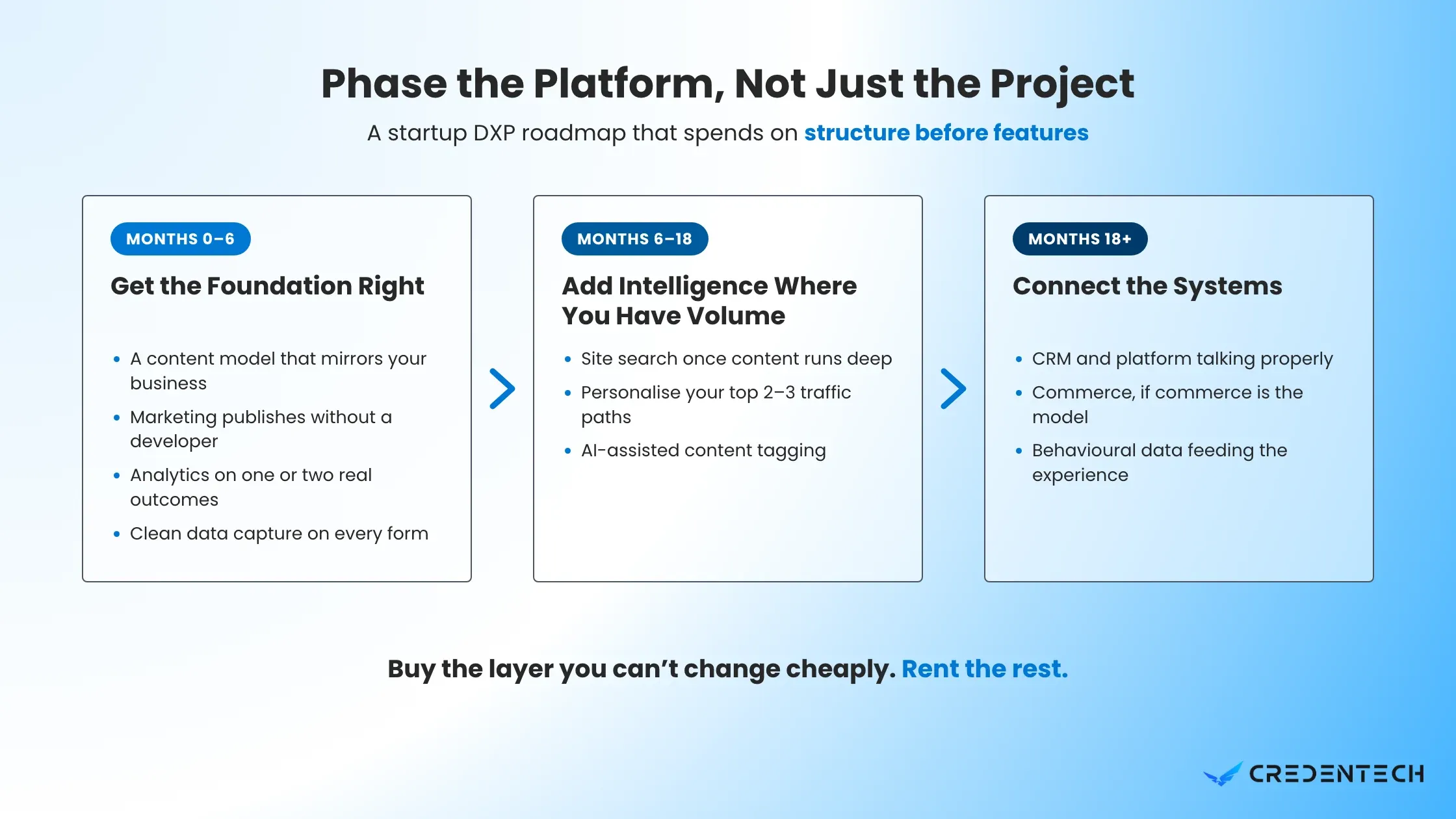
Phase two: add intelligence where you have volume (months 6 to 18)
Now you can justify it, because you have data.
- Site search, if you have enough content for people to get lost in it.
- Basic personalisation on the two or three highest traffic paths. Not the whole site. The two or three pages that carry your pipeline.
- AI assisted content tagging, which pays for itself the moment your library passes a couple of hundred items.
Phase three: connect the systems (months 18 and beyond)
- CRM and platform talking to each other properly.
- Commerce, if commerce is the model.
- Behavioural data feeding back into the experience.
The budget rules we would give a founder
Buy the layer you cannot change cheaply. Rent the rest. Your content model and your data structure are expensive to fix later. Your front end is not. Spend accordingly.
Avoid anything that requires a developer for routine work. The licence fee is rarely the real cost. The real cost is the queue in front of your one engineer.
Do not buy capability you will not staff. A platform with brilliant personalisation and nobody to run it is a more expensive version of the site you had.
Phase the contract, not just the project. Scope phase one properly, with phase two sketched and priced but not committed. Any partner who will not work that way is telling you something.
One honest caveat
Phasing costs a little more in total than doing it all at once, if you had the money and the certainty to do it all at once. You do not, and you should not pretend otherwise. The premium you pay for phasing is the price of not betting the company on a set of assumptions you have not tested yet. It is usually worth it.
We work with organisations at both ends of this, from Fortune 500 platforms down to companies on their first proper website. The phasing conversation is the same one.