

Launch day has a particular feeling to it. The team is relieved, someone posts about it, the invoice gets signed off, and everybody moves on.
Then nothing much happens for three months, and somebody asks why the new site is not performing.
The launch was not the finish line. It was the point at which you finally started collecting real information. Here is what to do with the next ninety days.
Week one: check it in the wild
- Every form, submitted for real, including the ones you assume nobody uses. Check the email actually arrives and lands in the right inbox.
- Redirects from the old URLs. Every important one. This is the single most common source of a traffic drop after a relaunch, and it is entirely preventable.
- Page speed on a phone on mobile data, not on office wifi.
- Search Console and your analytics, confirmed as reporting.
- Someone outside the project team using the site cold while you watch and say nothing.
Weeks two to four: find out what people actually do
- Watch real session recordings. Twenty is enough to see the pattern.
- Look at your site search queries. People are typing what they wanted and could not find. This is free product research.
- Check which pages get traffic and which get nothing. The gap between what you thought mattered and what visitors care about is always instructive.
- Talk to your sales team. Ask what enquiries look like now compared with before.
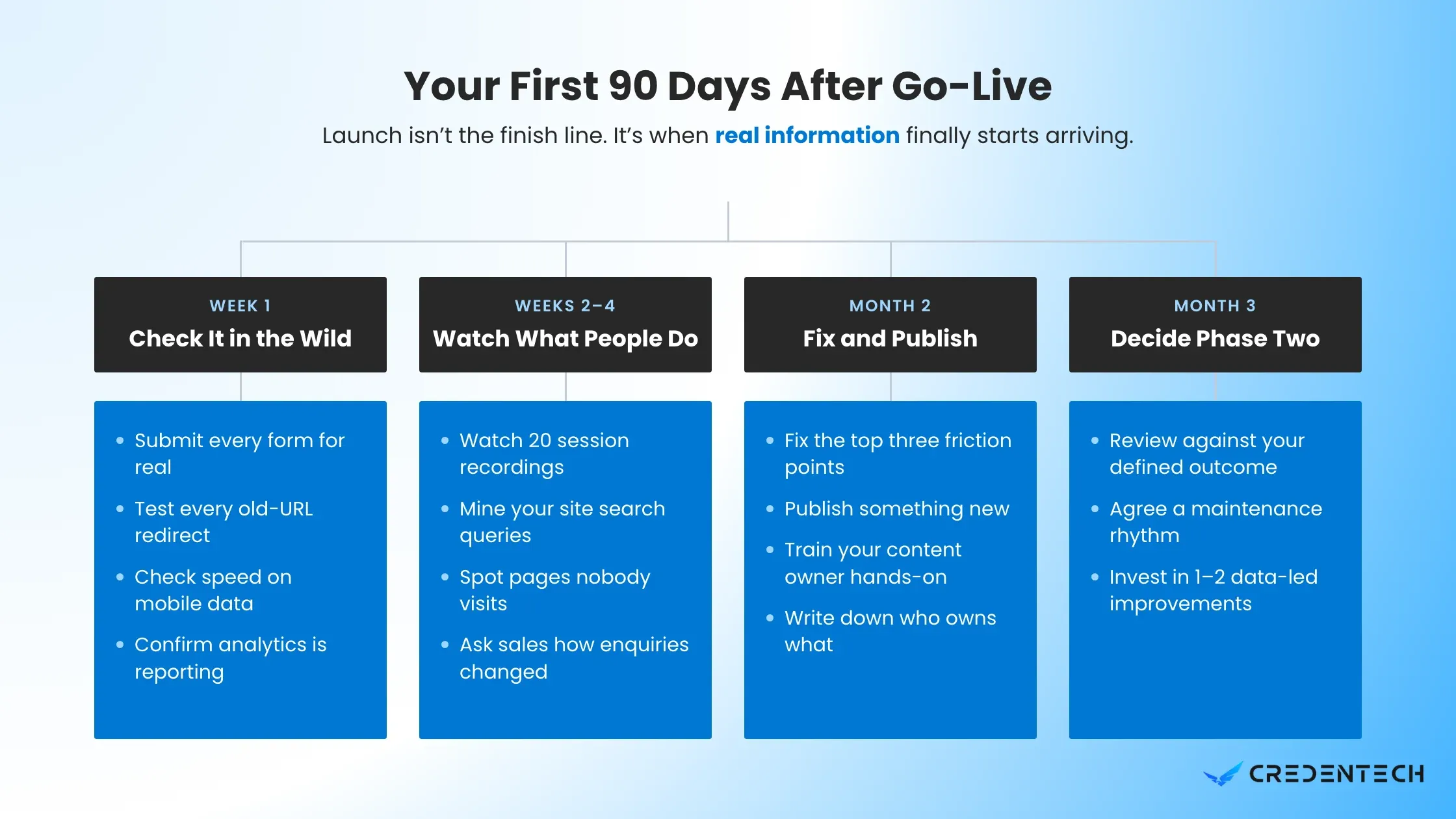
Month two: fix and publish
- Fix the top three friction points you found. Not all of them. The top three.
- Publish something. A case study, an update, anything. A site that has not changed since launch reads as abandoned, to both visitors and search engines.
- Train whoever owns content, properly, with them doing it rather than watching.
- Write down who is responsible for what, including the boring things like plugin updates and certificate renewals.
Month three: decide what phase two is
- Review against the outcome you defined before the build. If you did not define one, define it now, and accept that month one to three was your baseline.
- Agree on a maintenance rhythm. Security patches, platform updates, a quarterly content review.
- Pick one or two improvements worth investing in, based on what the data showed rather than what anyone assumed in the kickoff.
The thing we would most like people to take from this
A website is not a project that finishes. It is an asset that either compounds or decays, and which one it does is decided in the ninety days after everybody stopped paying attention.
This is why we structure our engagements to continue past go live rather than end at it. Not because we want a longer contract, but because the first three months of real usage teaches you more about your customers than the entire build phase did, and it is a waste to collect that and do nothing with it.