
There is a version of outsourcing that gives the whole model a bad name. You send over a specification, someone builds to the letter of it, you get back something that technically matches and practically does not work. Then you spend six weeks fixing it and conclude that outsourcing does not work.
We have also seen the other version, where an extended team becomes genuinely indistinguishable from the in-house one, ships faster, and stays for years.
The difference is almost never the talent. It is the setup.
What the good version has in common
One product owner on your side who can make decisions. Not a committee. Not a monthly steering call. One person who can say yes on a Tuesday.
Shared working hours, even if only a few. You do not need full overlap. You need a reliable window where questions get answered in minutes rather than the next day. Two or three hours is usually enough.
Access to context, not just tickets. If the team only ever sees the task, you will only ever get the task. Let them see the roadmap, the customer complaints, the sales objections. People solve better problems when they know what the problem is for.
A definition of done that includes quality. Written before the first sprint. Tests, documentation, browser coverage, accessibility. If it is not written down it will be argued about later.
Named people, not a pool. Continuity is most of the value. Someone who has worked on your platform for eighteen months is worth several people who are learning it fresh.
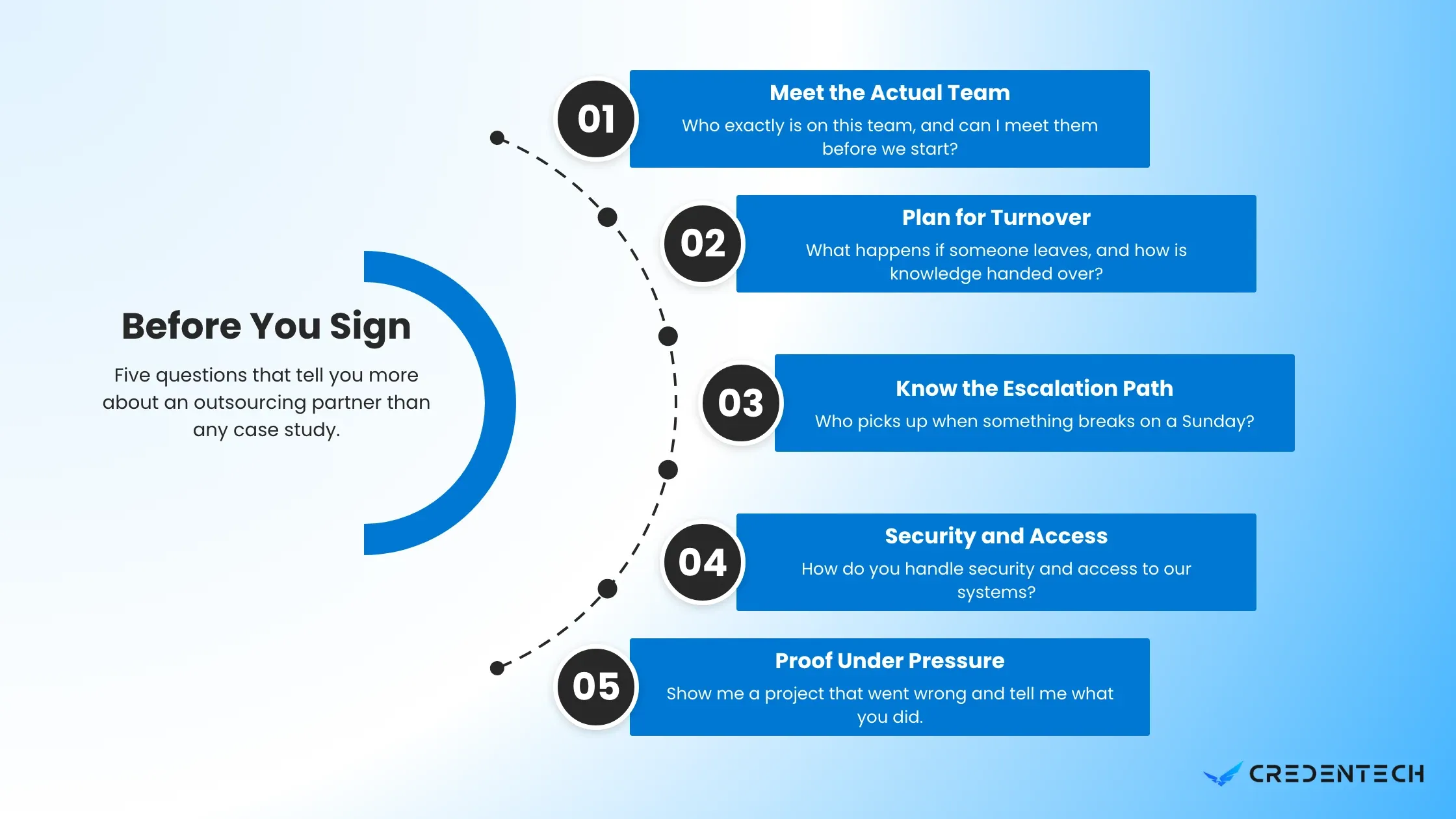
What to ask a partner before you sign
A short list we would be happy to be asked ourselves:
- Who exactly is on this team, and can I meet them?
- What happens if one of them leaves, and how is knowledge handed over?
- What is your escalation path when something breaks on a Sunday?
- How do you handle security and access to our systems?
- Show me a project where something went wrong and tell me what you did.
That last question tells you more than the case studies.
Where it works best
Outsourced talent is strongest for sustained work. Platform support, ongoing development, maintenance, upgrades, a steady stream of feature work. It is weakest for short bursts of highly ambiguous discovery, which usually needs to happen in the same room.
Most businesses we speak with need both. The discovery is intense and brief. The build and the running of it lasts years. Structuring for that reality, rather than pretending one model covers everything, is where the money is saved.