
Ask most owners what their website is for and you will get some version of “so people can find us.” Fair enough. That was true for about fifteen years.
It is a low bar now, though, and the gap between a site that exists and a site that works has turned into real money.
We want to make the case positively, because the scare stories about bounce rates have been done to death. Here is what good looks like, and what each piece is worth.
Good looks like this
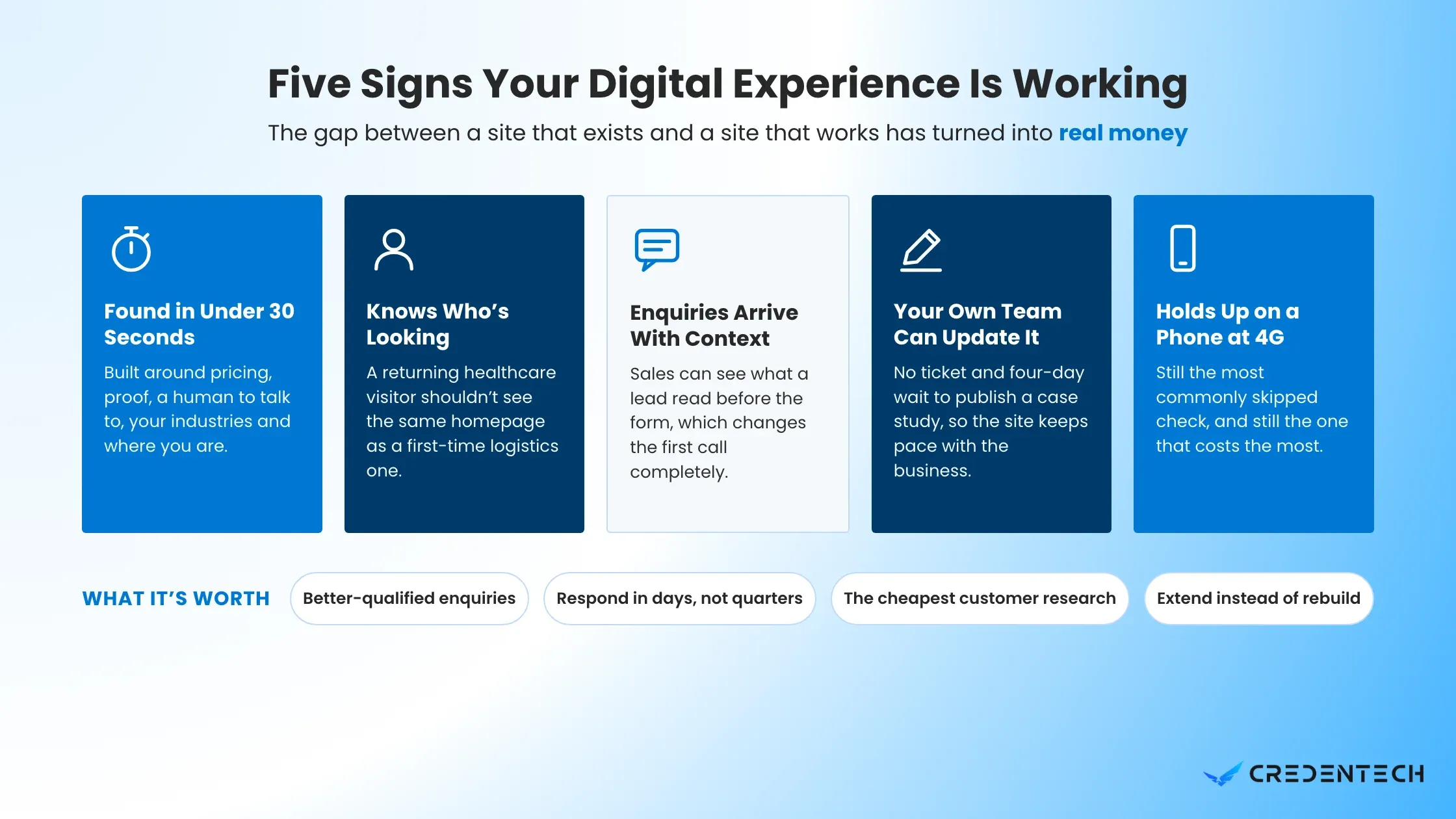
People find what they came for in under thirty seconds. Not because the navigation is clever, but because the site was built around the four or five things visitors actually want. Pricing. Proof. A human to talk to. Whether you serve their industry. Where you are.
The site knows something about who is looking. A returning visitor from a healthcare company should not see the same generic homepage as a first time visitor from a logistics firm. This used to require an enterprise budget. It does not any more.
Enquiries arrive with context attached. Your sales team should be able to see what the person read before they filled in the form. That single piece of information changes the first call completely.
Your own team can update it. If publishing a new case study means raising a ticket and waiting four days, your site will always be six months behind your business.
It holds up on a phone at 4G. Still the most commonly skipped check, and still the one that costs the most.
What that is worth
The honest answer is that it depends on your sales cycle, and anyone quoting you a universal percentage uplift is guessing. But the mechanics are consistent:
- Better qualified enquiries mean your sales team spends time on people who can buy. That is a cost saving before it is a revenue gain.
- Content your marketing team can publish without engineering support means you can respond to the market in days rather than quarters.
- Behaviour data from your own site is the cheapest customer research you will ever run.
- A platform that can be extended rather than rebuilt turns a recurring capital expense into a manageable operating one.
Where most businesses actually are
Somewhere in the middle. A site that looks reasonable, was built three or four years ago, is difficult to update, and nobody is quite sure what it is doing for the business because nobody has ever measured it.
That is a normal place to be. It is also a very fixable one, and it usually does not start with a rebuild. It starts with working out which of the five things above you already have.
At Credentech we spend a lot of time on that first conversation, with businesses of every size. It is the cheapest hour in the project and it saves the most money.