
Personalization has shifted from design to decisioning
Personalization used to be about better experiences.
Better journeys. Better content. Better UX.
That’s no longer where teams get stuck.
What slows personalization today is not creativity; it’s how decisions move inside the organization. When every change depends on new segments, refreshed models, or multiple handoffs, relevance degrades quietly. Not because teams lack intent, but because decision velocity collapses under process.
Customers don’t wait for internal alignment.
Intent appears, shifts, and disappears often within the same interaction.
This is where personalization stops being an experience problem and becomes a decisioning problem, one that increasingly defines how AI-led platforms deliver value.
Why personalization slows down when decisions depend on data cycles
Most enterprises already have more customer data than they can activate meaningfully.
The constraint isn’t insight. It’s speed with control.
The prevailing operating model still looks like this:
- Data is collected and processed
- Segments are created from historical patterns
- Campaign logic is built around those segments
- Experiences are deployed after validation cycles
This model assumes intent is predictable.
It isn’t.
Intent is contextual and transient. When decisions depend on retrospective analysis, personalization becomes accurate, but late. Over time, this gap creates a subtle but persistent drag between strategy and execution.
How segmentation creates decision latency at enterprise scale
Segmentation isn’t inherently flawed.
Dependence on segmentation is.
At scale, it introduces structural friction:
- Decisions queue instead of flow
- Ownership centralizes instead of distributing
- Optimization cycles stretch beyond the moment of intent
Each new use case competes for analytical bandwidth.
Each refinement waits for validation.
This is an operational blindspot many organizations underestimate: personalization stalls not because teams can’t move but because the system is designed to slow them down.
What real-time decisioning changes about how personalization actually works
Real-time decisioning removes the wait state.
Instead of asking:
“Which segment does this customer belong to?”
The system evaluates:
“Given current signals and business priorities, what should happen now?”
This shift introduces three practical changes:
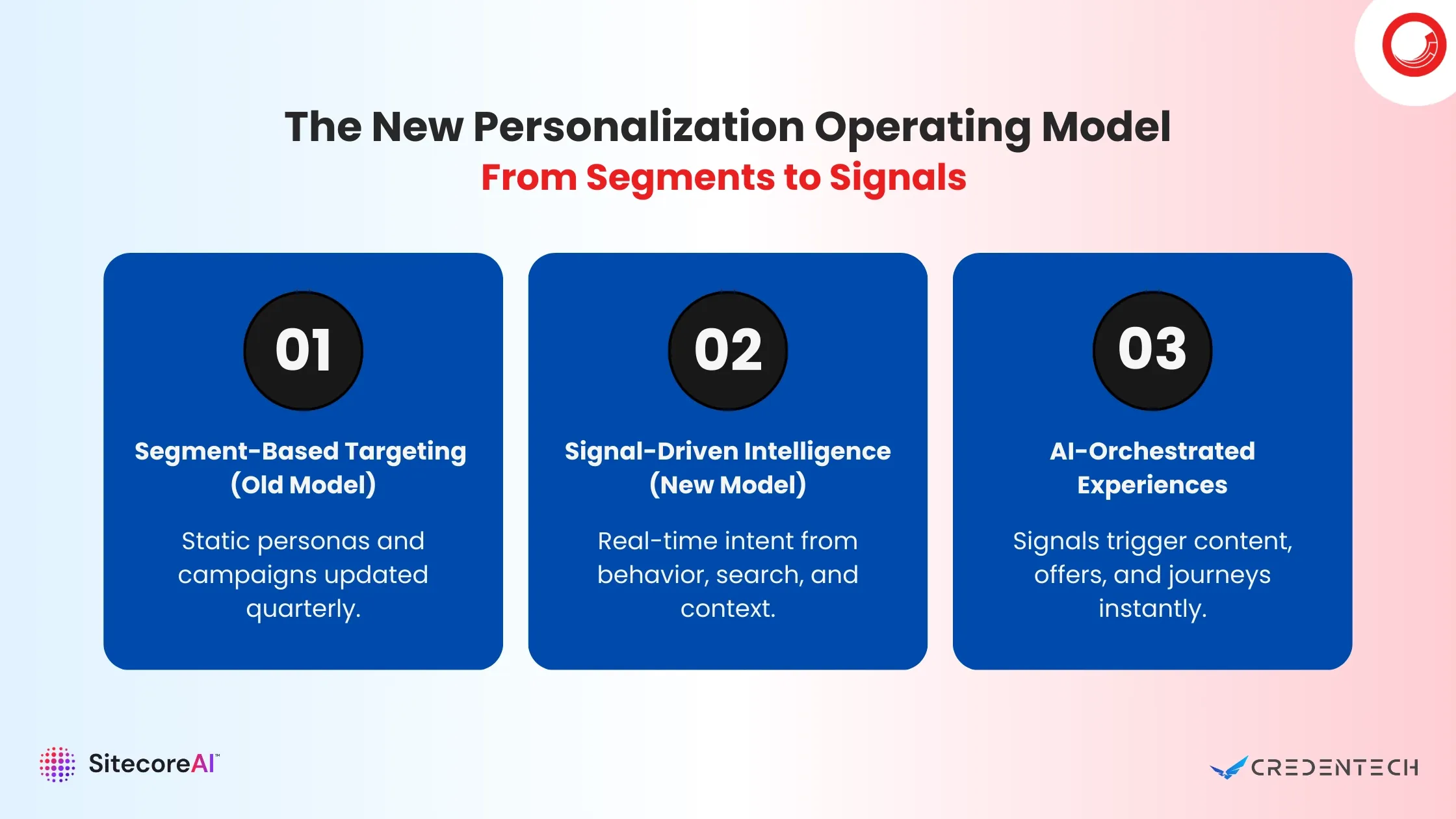
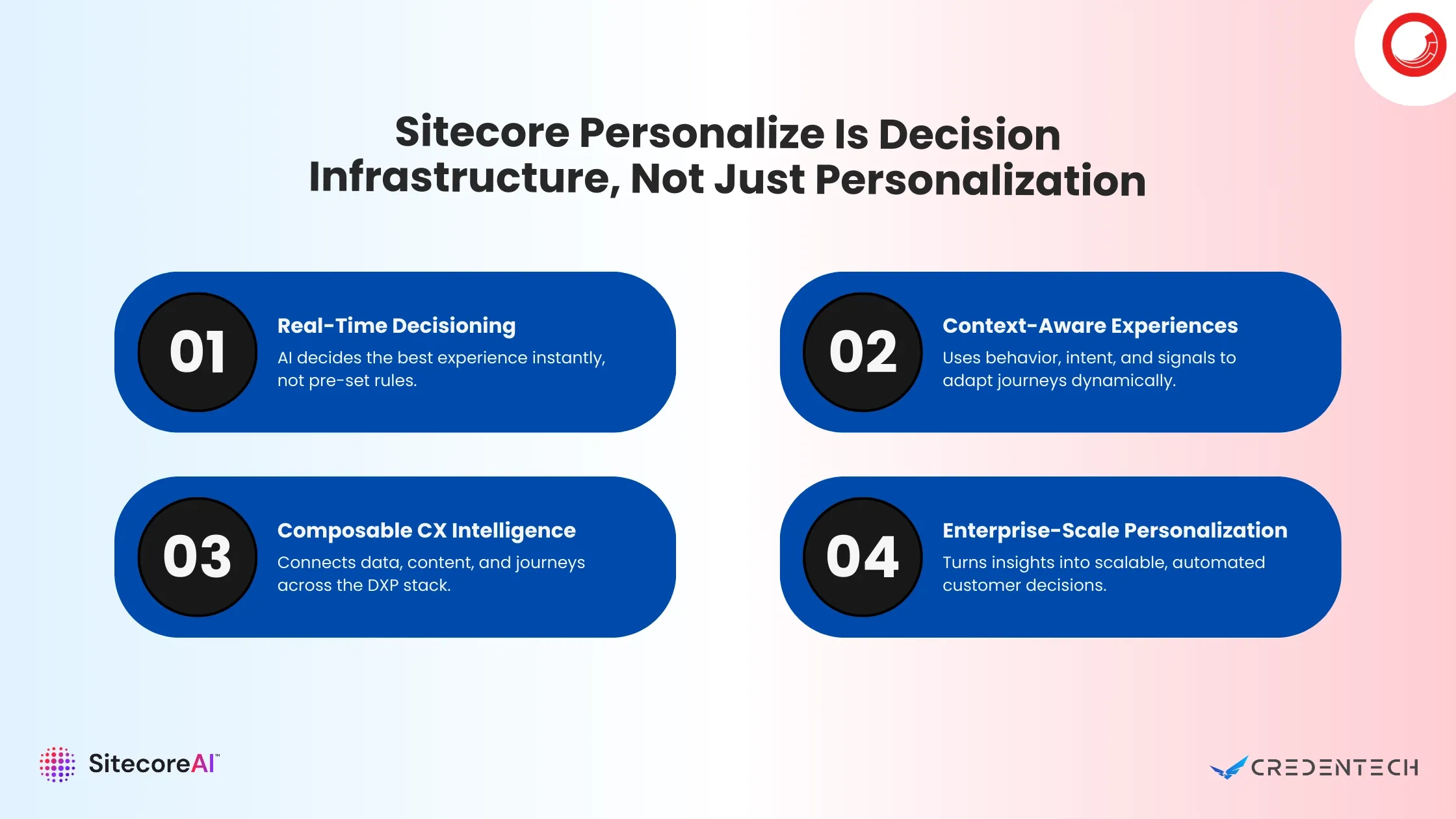
- Signals over attributes - Decisions respond to live behavior and context, not static profiles.
- Logic over lists - Business intent is expressed through decision rules, not audience definitions.
- Continuity over campaigns - Personalization becomes continuous, aligned with how customers actually behave.
At this point, personalization stops being a marketing execution layer and starts functioning as decision infrastructure, a role increasingly central to AI-led experience platforms.
This notion of decision infrastructure is also the foundation on which Sitecore AI is designed, applying intelligence at the moment decisions are made, not after experiences are already defined.
From segments to signals: operationalizing intent in the moment
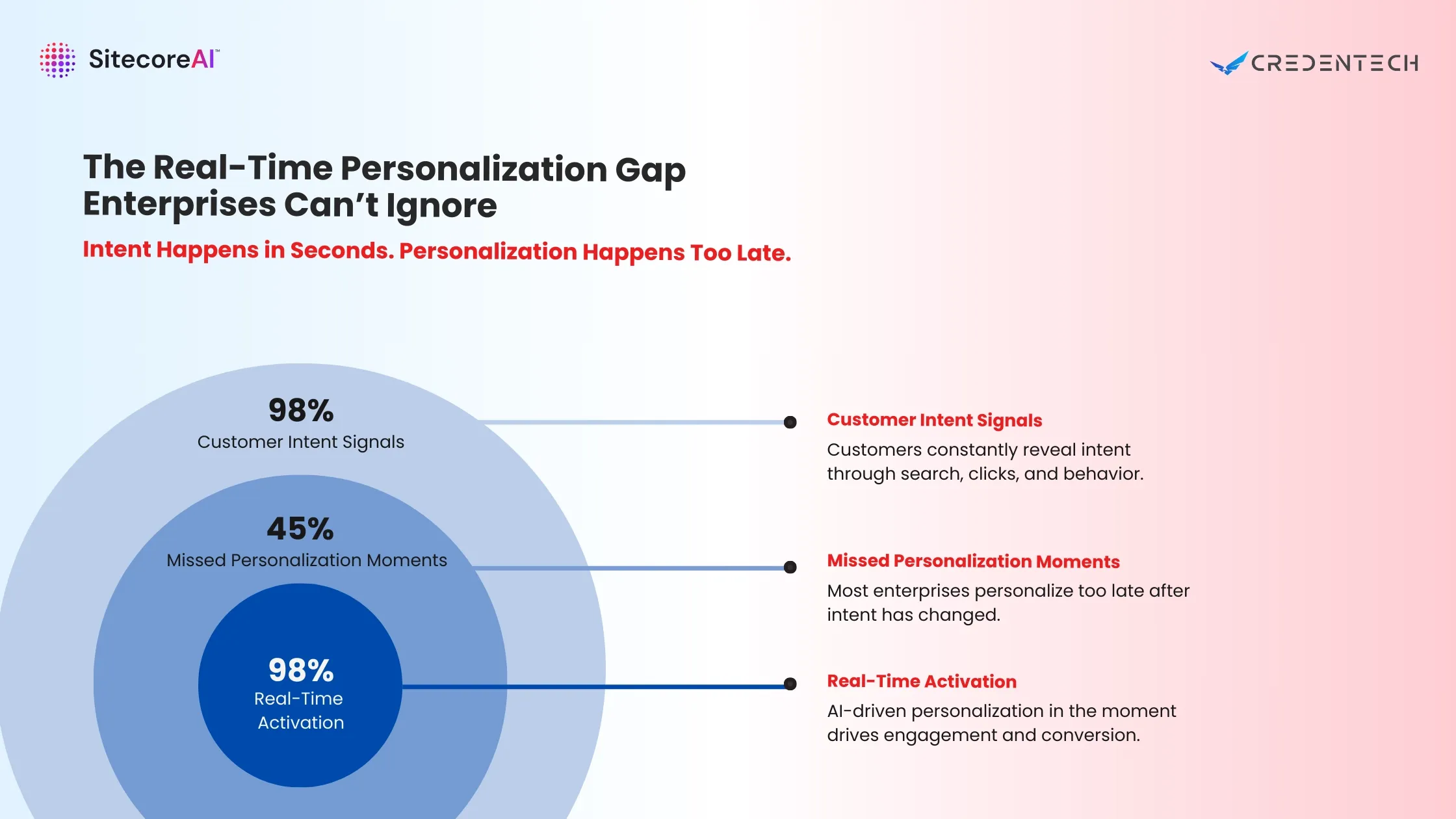
Signals represent intent under context, not just activity.
They appear as:
- Hesitation where conversion is expected
- Deviations in high-value journeys
- Cross-channel inconsistency
- Sudden behavioral shifts that defy historical norms
- Segment-led systems struggle here because they look backward.
Signal-led decisioning evaluates:
- What is happening now
- Why it matters commercially
- Which outcome should be prioritized
This is where personalization moves from reactive optimization to real-time orchestration.
Where Sitecore Personalize fits in the decisioning stack
Sitecore Personalize is often viewed through the lens of personalization.
Its real value emerges when it is treated as decisioning infrastructure.
Used this way, it enables teams to:
- Act on signals as they occur
- Apply business logic without rebuilding segments
- Maintain consistency across channels
- Reduce reliance on batch-driven processes
The distinction is subtle but critical: defining audiences versus governing decisions.
That shift is what allows AI-driven experiences to scale without adding operational drag.
Why delayed decisions lose value faster than data loses accuracy
When customer behavior changes quickly, delayed decisions lose relevance.
In these conditions, personalization delayed is personalization diluted.
Decisioning-led architectures absorb volatility instead of reacting to it. They allow organizations to respond as context unfolds rather than explain outcomes after the fact.
That capability increasingly sits at the core of modern AI experience strategies.
The operating model most organizations underestimate
Technology alone doesn’t remove bottlenecks.
Operating models do.
When personalization is anchored in real-time decisioning:
- Teams move within defined logic, not approval chains
- Data functions enable instead of gatekeep
- Governance is embedded into rules, not process
Where initiatives stall, it’s rarely due to tooling.
It’s a mismatch between modern platforms and legacy ways of working.
Credentech’s perspective: decision infrastructure before experience design
At Credentech, personalization work doesn’t start with experiences.
It starts with decision clarity.
Across complex Sitecore environments, we consistently see impact improve when teams:
- Identify which decisions truly drive outcomes
- Expose where latency enters the system
- Design decision logic before layering creativity
This is how personalization aligns naturally with broader AI initiatives where intelligence is applied upstream, not patched on later.
From personalization decisions to AI-driven experience strategy
When personalization feels slower than expected, the issue is rarely tooling.
It’s where decisions wait.
Mapping decision latency where it enters, who owns it, and how quickly it can change often reveals why AI initiatives struggle to move beyond experimentation. Without real-time decisioning, intelligence stays descriptive instead of actionable.
This is why decisioning has become the connective tissue between personalization and AI-led experience strategy.
Platforms like Sitecore AI are built around this principle: not adding intelligence after the fact, but embedding it where decisions are made continuously, contextually, and at scale.
If you’re exploring how AI should actually function across your experience stack, this is the layer worth examining first.
No demos. No pitch. Just clarity on whether your personalization foundation is ready for AI to do real work.